
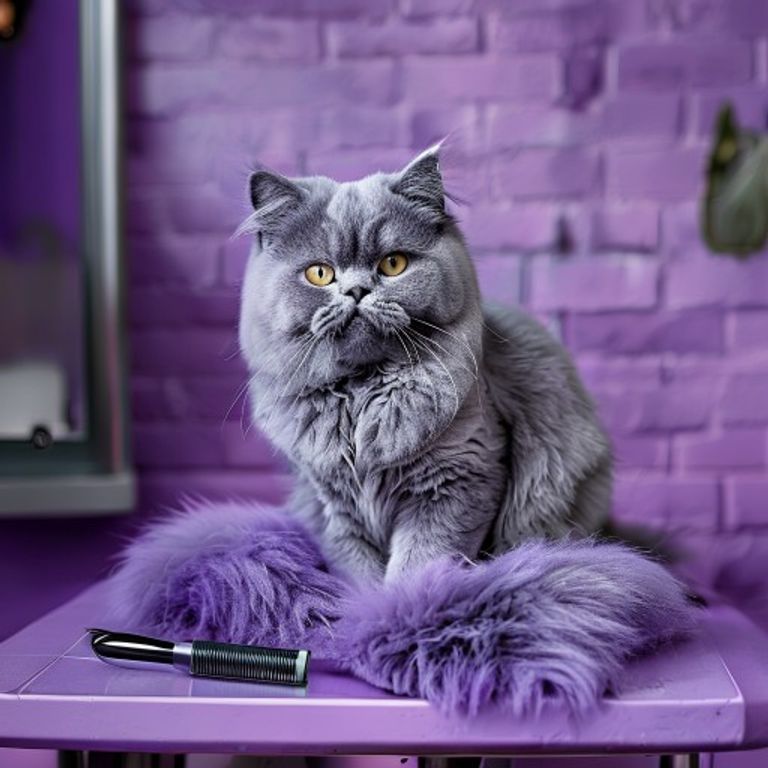
If every spring and autumn your home looks like a pillow exploded in it, and the lint roller has become a daily essential — that's seasonal shedding. Vacuuming won't win: while you clean fur off the sofa, more is already flying off your pet. There is a procedure that solves the problem at the source — express de-shedding. Let's look at what it is, who needs it, and why your home really does get cleaner afterwards.
What the undercoat is and where all that fur comes from
Most cats and dogs have a double coat: coarse guard hair on top and a soft, fluffy undercoat underneath. It's the undercoat that handles thermoregulation — and it's the undercoat that dies off and renews en masse twice a year, in spring and autumn. Dead fluff doesn't shed all on its own: it gets stuck in the coat, comes out in tufts all over the house, and whatever doesn't come out felts into mats. Ordinary brushing only takes the top layer — a home brush can't reach the dense undercoat next to the skin.
What express de-shedding is
It's the intensive removal of dead undercoat in a single session. The pet is washed with a special shampoo and treated with a mask that lift and "unstick" the dead fluff from the skin, then dried with a powerful blaster dryer — which literally blows the dead fur out — and combed through with professional tools layer by layer, down to the skin. In one procedure we remove the volume of undercoat that would otherwise have ended up on your floor, sofa and clothes over the coming weeks.
The key thing to understand: shedding is a process, not a one-off event
Here we'll be honest, because express de-shedding attracts a lot of inflated expectations. The procedure does not "switch off" shedding and cannot stop biology — no grooming in the world works that way. Let's see why, so you know exactly what you're paying for.
Fur doesn't die all at once, on command. Each hair lives by its own cycle: it grows, pauses, dies and falls out — and at any given moment the hairs are in different phases. The undercoat renews gradually, in waves: some fluff has already died and is ready to fall today, some has only just begun to die and will leave the coat in a week or two, and some is still holding firm — its time simply hasn't come.
The job of express de-shedding is to remove exactly what's shedding here and now: all the dead undercoat that, by the time of the procedure, has already matured and would have ended up on your sofa in the coming days anyway. We take out that volume in one go, carefully and down to the skin. But speeding up the dying of living fur is impossible — it will mature in its own time and start falling later. That's how nature designed it, and it's normal.
So the honest expectation is this: right after the procedure there will be dramatically, noticeably less fur at home — we took everything that was ready to fall. But as the next "wave" of undercoat matures, some fur will return over time. That doesn't mean "it didn't work" — it means shedding is running its natural course. Put simply: express de-shedding is not a magic "shedding off" button, but a professional deep-clean of the undercoat. We don't argue with biology — we take away all the surplus it has already released, so it stays with us and not in your home.
And, honestly: stress and the procedure itself matter too
There's a nuance people rarely warn about, though they should. A trip to the salon is stressful for a pet, even one that looks calm: a new place, unfamiliar smells, the noise of the dryer, other animals around. And in cats and dogs stress increases shedding — that's a proven bodily reaction. On top of that, the procedure itself: washing, drying and combing remove a large volume of undercoat.
So be prepared: in the first day or two after the visit your pet may shed a little more than usual. It's easy to take this as a worrying sign — as if grooming only made shedding worse. But it's temporary and harmless: the body is simply getting rid of the fur that was ready to fall out anyway. Usually within a few days everything returns to normal — and that's when you notice there's less fur around the house.
For our part, we do our best to keep stress to a minimum: we work calmly, without rushing or roughness, and let the pet settle in. And at home after the visit, it's best to let your pet rest quietly — don't fuss over them or arrange noisy reunions. That way they'll calm down faster, and shedding will return to normal sooner.
When it's not about the season: diet and health
It's important to tell the difference: seasonal shedding is normal, but heavy fur all year round, regardless of spring and autumn, is already a reason to look more closely at your pet's health. Constantly falling, dull or brittle fur, bald patches, dandruff and itching can point to an unbalanced diet (lack of fatty acids, vitamins, protein), thyroid problems, hormonal imbalances, parasites or allergies. No grooming will cure that — express de-shedding removes the consequences, not the cause.
So if you notice the fur falling out noticeably more than usual, coming out in tufts out of season, or its quality clearly changing — show your pet to a vet. And quality food and enough water are a simple foundation that noticeably improves coat condition in most animals. A groomer will put the coat in order and remove the excess undercoat, but truly healthy fur starts from within.
Who needs it
First and foremost — owners of fluffy breeds with a dense undercoat. Among cats these are British, Scottish Fold, Maine Coon, Siberian — they shed so much you can gather the fur by the handful. Among dogs — Spitz, Husky, Malamute, Corgi, Samoyed, Labrador. If your pet "sheds" year-round or you have an allergy sufferer at home, the procedure can be done off-season too. But breeds without an undercoat (poodles, Yorkies, toy terriers) don't need express de-shedding — regular hygiene and a haircut suit them.
Why it's better than "just shaving"
The temptation to solve it all with clippers is strong, but shaving a double-coated pet down to the skin is a bad idea: it disrupts thermoregulation, the coat afterwards often grows back worse and with bald patches, and shaved skin is unprotected from the summer sun. Express de-shedding removes only the dead fluff and doesn't touch the guard hair — the pet keeps its "coat" but without the excess ballast: it's easier for them in the heat, and cleaner for you at home.
How often to do it
As a rule, twice a year — at the peak of spring and autumn shedding. But, as we explained above, shedding comes in waves: at the height of the season, for heavy shedders it makes sense to repeat express de-shedding in 2–3 weeks, to remove the next, now-matured "wave" of undercoat. Off-peak, a single visit usually lasts a long time. The exact rhythm depends on the breed and coat condition — the groomer will advise at the visit, and in your personal account on our site the tracker will remind you when it's time.
Tired of gathering fur all over the house? Come in for express de-shedding — in a single visit we'll remove the dead undercoat, and your home will get noticeably cleaner.